Baking Journal
Why Did My Cake Sink in the Middle?
A cake that rises then sinks may be underbaked or over-aerated. Check leavening, mixing, oven temperature, and pan size with this troubleshooting guide.
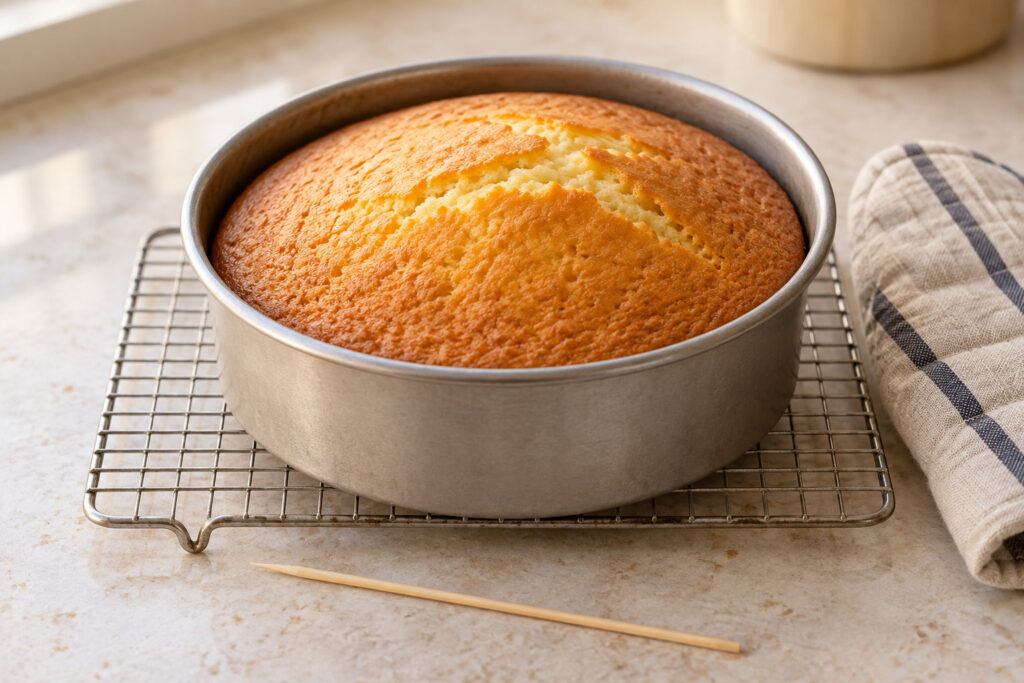
A cake rises in the oven, then collapses into a dip as it cools. The center may look wet, gummy, or simply lower than the edges. A sunken cake usually means its structure did not set before the rise became too ambitious. The fix is not always “bake it longer”: check the leavener, measurements, mixing, oven temperature, pan, and doneness together.
1. The center was underbaked
The cake’s edges can look finished while the middle is still too soft to support itself. Follow the recipe’s time as a guide, then check the center with more than one clue. The top should spring back gently when pressed, and a tester inserted near the middle should come out with a few moist crumbs rather than liquid batter. A digital thermometer can help for some sturdy cakes, but use a recipe-specific temperature when one is provided.
If the center is still wet, return the cake to the oven and check again after a few minutes. Tent the top loosely with foil if it is already deeply browned. Our guide to checking cake doneness explains why one toothpick test is not enough on its own.
2. Too much baking powder or baking soda
More leavener does not guarantee a higher cake. Too much gas can push the batter up before the crumb is strong enough to hold it; the center then sinks as bubbles escape. This often happens when a teaspoon is heaped, a tablespoon is mistaken for a teaspoon, or a recipe has been scaled without adjusting every ingredient accurately.
Measure leaveners with level measuring spoons, and check that the recipe uses baking powder or baking soda as written. They are not direct one-to-one substitutes. If you suspect the formula itself is unbalanced, test a trusted recipe before altering the chemical leavener by guesswork.
3. The oven temperature is off
An oven that runs cool can leave the center unset for too long. An oven that runs hot can make the outside and top set while the middle is still expanding, which encourages a collapse. An inexpensive oven thermometer can show whether the temperature at the rack matches the dial. Give the oven time to preheat fully, and place the pan on the rack specified by the recipe.
Try not to open the door repeatedly during the first part of baking. If you need to rotate the pan because your oven heats unevenly, wait until the cake has started to set and follow the recipe’s guidance.
4. Mixing introduced too much air—or too little structure
In butter cakes, creaming butter and sugar is meant to incorporate air, but beating far beyond the recipe’s directions can create a batter that rises too fast and then falls. On the other hand, stopping too early can leave dry ingredients unevenly incorporated and the crumb weak. Use the speed and timing in the recipe; scrape the bowl when instructed so the mixture combines evenly.
Once flour is added, mix only as long as the recipe says. Excessive mixing can make a cake tough, but the opposite extreme is not a solution: some batters need a brief final mix to develop enough structure. Follow the specific mixing directions rather than applying a universal “never mix” rule.
5. The pan or recipe size changed
A smaller pan makes a deeper layer, which takes longer to bake through. A larger pan creates a shallower cake that may finish sooner. If the batter is too deep, the edges can overbake before the center is ready. Use the pan size given in the recipe, and do not fill it beyond the recommended level. If you substitute a pan, use a tested conversion and start checking for doneness at an appropriate time.
6. The cake was disturbed before it set
Moving a liquid cake early, slamming the oven door, or pulling it out before the crumb sets can cause a delicate center to drop. Let the cake bake undisturbed through the early stage. Once it is fully baked, cool it according to the recipe; a cake that sinks slightly as it cools is not necessarily a failure, but a deep crater and gummy center point to a baking or formula problem.
A simple troubleshooting order
- Check the center for underbaking and verify the pan size.
- Confirm that the oven is reaching the recipe temperature.
- Level-measure baking powder and baking soda; check the labels.
- Review mixing times, especially creaming and the final flour mix.
- Change only one variable on the next bake and note the result.
If a cake has already sunk, let it cool and taste the center. A fully baked dip can still be served with fruit or frosting. If the middle is raw, do not serve it as-is; return it to the oven if it is still hot and salvageable. Once you know whether the problem was underbaking, leavener, or mixing, the next batch becomes much easier to troubleshoot.